You can, and should, ignore most suffering
Celebrate your privilege
Summary: The essay argues that individuals can and should ignore approximately 99% of the suffering presented to them through media and social platforms. Banks contends that most distant suffering is delivered by people with financial or personal stakes in commanding attention, and that retaining anxiety about these events provides no practical benefit. Instead, the author advocates focusing attention on high-leverage personal tasks and appreciated presence in one's immediate life.
This morning I woke up and, like most mornings, immediately went on my phone. I have a routine of apps I cycle through as my brain begins to boot up: first I’ll open Substack and read the notifications, then I’ll open X and scroll, maybe YouTube Shorts if my wife is out of bed already, and if I’m truly running out of content, sometimes I’ll open Reddit. I’ve been doing some version of this basically every day since I was thirteen, and it is as close to a morning ritual as I’ve ever had.
Today while on X I saw some news about a murder, and it spiked my cortisol substantially, to the point my heart rate noticeably increased.
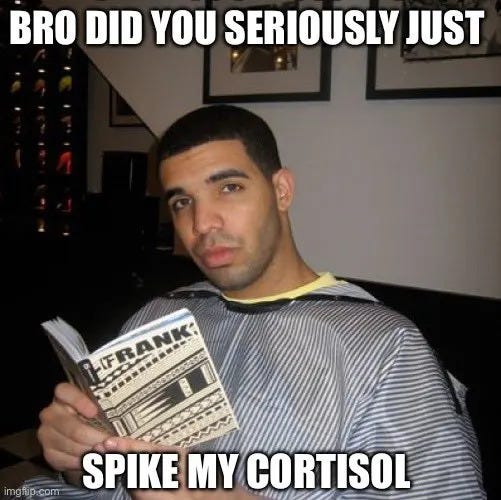
But since my brain was still turning on, I cannot even remember a single detail about the murder. Was it a young woman? In my state? Even from this year? I don’t know, but I do know it stressed me out.
I contrast that with the walk I went on afterwards. I remember very little of that walk either, but my impression is one of wonder at the miraculous beauty of life awakening on a crisp April morning in Northern Virginia.
So what even was the point of going on social media? It isn’t like I remember anything important either way — and even if I did, so what?
The truth that no one who produces content wants to admit is that you can basically ignore about 99% of the suffering in the world. You are almost certainly a middle-class Anglo who lives a lifestyle your ancestors would have described as utopian, so live it!
Look around you — how much of the suffering you are told to attend to is delivered by people with a personal or financial stake in your attention? How much of it would creep back up on you if you simply put it in a box and ignored it?
In front of you right now are high-leverage tasks that demand your attention, tasks that will improve your life and the lives of the people you love if you focus on them. And if you want to focus on politics, as I do, there are topics like the deficit — which will actually affect your life in a way that a random kidnapping simply won’t. What does sharing in the suffering of strangers do, other than pollute my mind with data that doesn’t map to my life?
Many people I know are afraid of kidnapping, but I don’t know anyone who has been kidnapped. In fact, I haven’t even heard anyone claim to know someone who was kidnapped! By contrast, I know people who have killed themselves or ruined their lives in a swamp of self-imposed misery.
Joymaxx, young Anglo.
Since I cannot close an article without a quote from Carlyle:
“Let no meanest man lay flattering unction to his soul. Louis was a Ruler; but art not thou also one? His wide France, look at it from the Fixed Stars (themselves not yet Infinitude), is no wider than thy narrow brickfield, where thou too didst faithfully, or didst unfaithfully. Man, ‘Symbol of Eternity imprisoned into Time!’ it is not thy works, which are all mortal, infinitely little, and the greatest no greater than the least, but only the Spirit thou workest in, that can have worth or continuance.” — The French Revolution