Why I love Thomas Carlyle.
Carlyle was a flawed man, and I never expect him to develop a broad modern audience. But, I will continue to call myself a Reformist Carlylian because so much of what he wrote was true.
Summary: The essay examines the enduring significance of 19th-century Scottish philosopher Thomas Carlyle, whose influence on 20th-century thought was profound but whose legacy has been largely forgotten. Carlyle's metaphysics center on veracity and the divine nature of the universe, informing his great man theory (Hero Worship), which posits that selecting and empowering the most righteous individuals should be government's central objective. The author argues that understanding Carlyle is essential to comprehending the 20th century and that his insistence on confronting reality remains intellectually valuable for modern audiences.
I wanted to write about why I love Thomas Carlyle.
First off: Who is Carlyle? He was a 19th‑century Scottish philosopher, historian, and author who was immensely influential during the Victorian period, but has since faded from public consciousness.
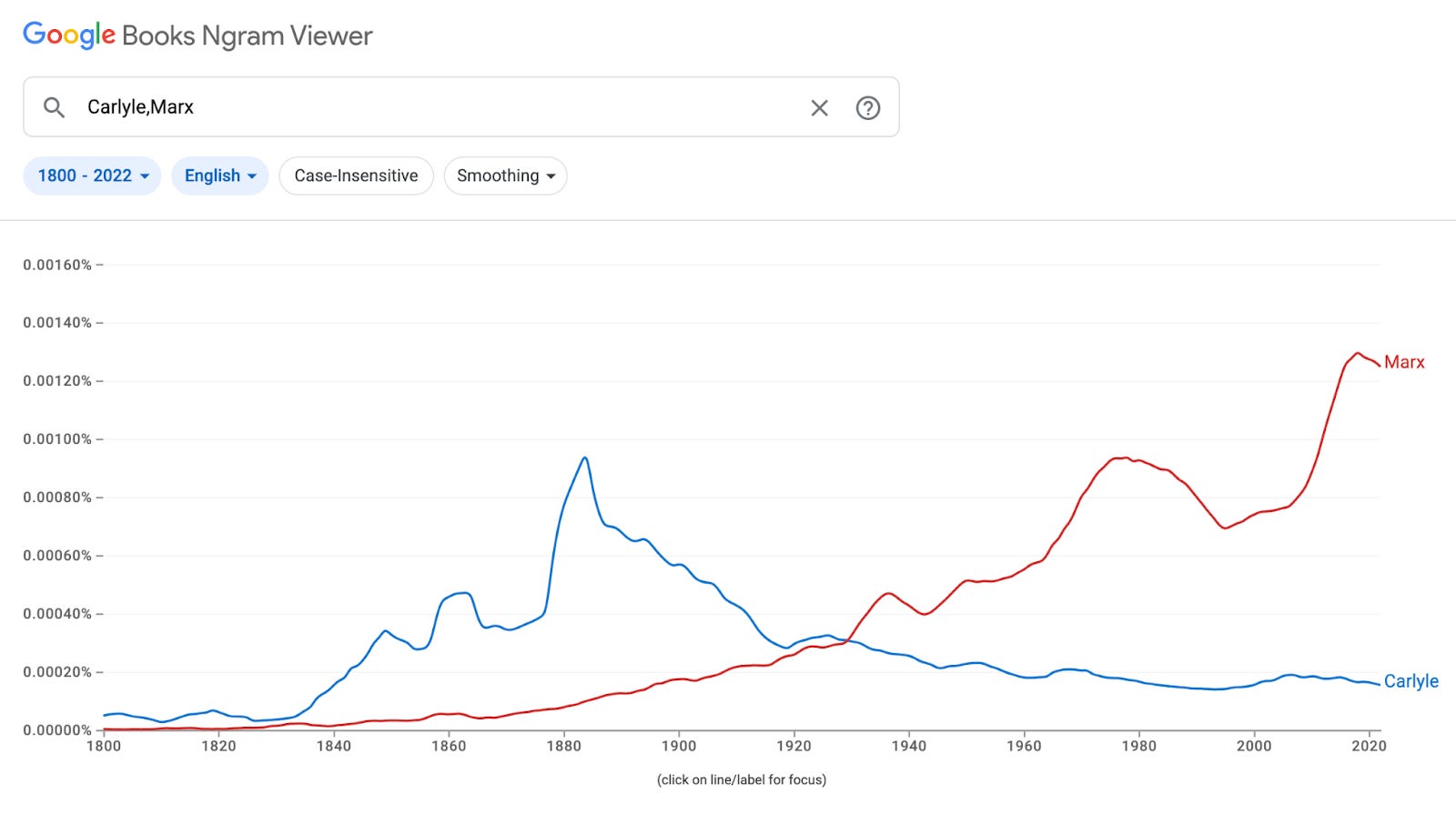
In many ways, Carlyle is akin to thinkers like Herbert Spencer or Voltaire—people who had a profound impact on our thought but who have largely been forgotten.
Carlyle is unique, though, because even in his own era he was a dying breed. He was a sort of last gasp in “medieval” (or really, early modern) Anglo civilization before it was permanently transformed by the Industrial Revolution. His influence was widely felt across every political ideology of the 20th century, from socialism to fascism.
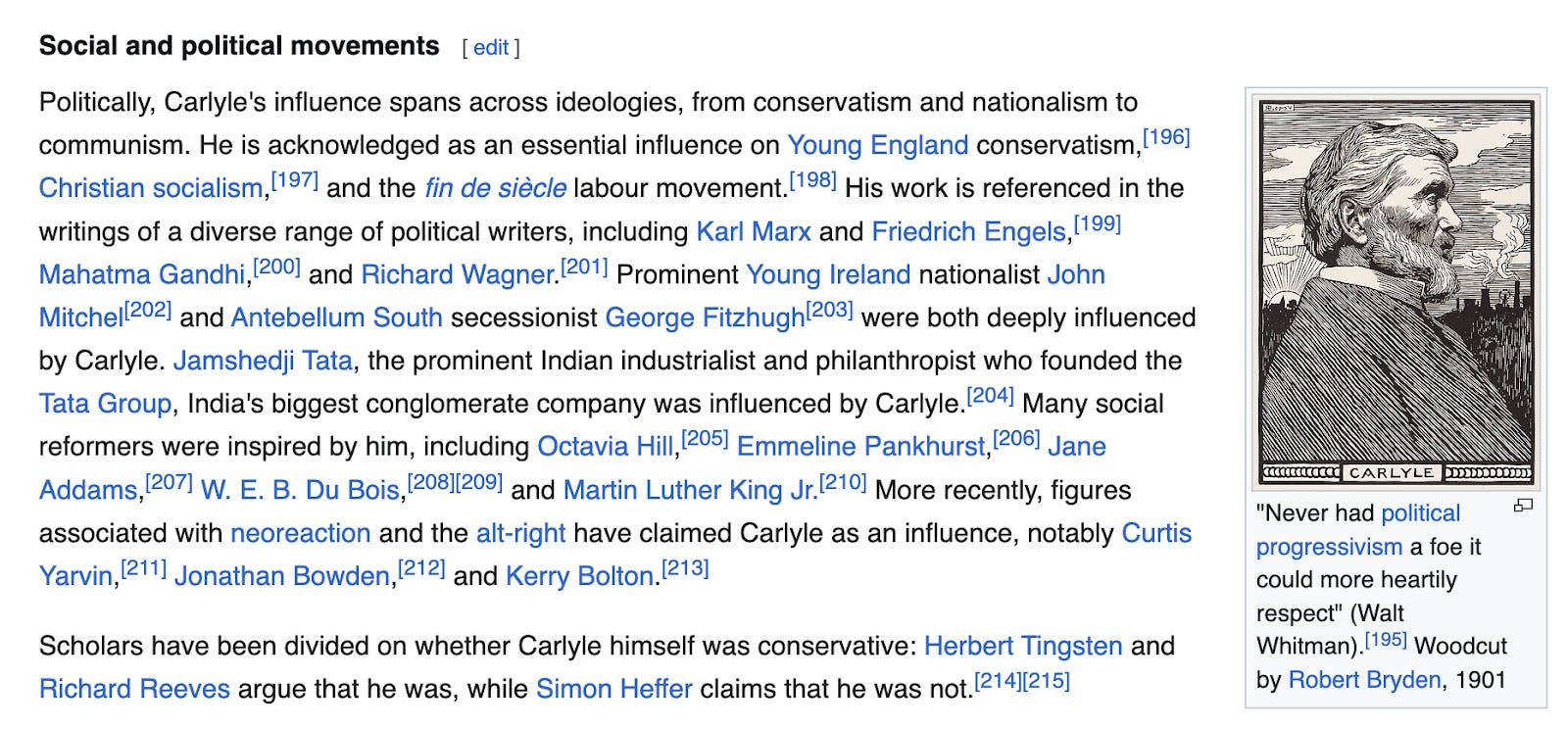
To really understand the 20th century, I think you have to understand Carlyle. For that alone, he is worth reading.
It goes beyond this. Since the 20th century was, in many ways, such a complete shit show, Carlyle gives us the chance to revisit earlier attempts to answer the perennial questions of Human life in a manner untainted by the twin cataclysms of WW1 and WW2. Questions about how to organize society, what the purpose of human existence is, and whether morality exists at all—in other words, questions I believe we are deeply confused about.
So what were Carlyle’s answers to these question? I think to understand that you need to understand Carlyle’s God. But before I do that I want to make it very clear that I am not an academic student of the Victorian sage, so much of this could be wrong. I cannot emphasize enough how much I recommend that you check him out yourself.
Carlyle’s metaphysics is based on a belief in the necessity of Veracity—that we have an obligation to be honest and that lies are the origin of all evil. Once we are honest, we are forced to acknowledge the miraculous nature of our Universe. That there is evidence of divinity in everything, from the processes of nature to the functioning of high civilization. Everything, from the smallest labor to the highest achievement1, echoes in eternity in a way that defies logical systems; in fact, we risk being swallowed by our logical systems if we pretend that they, rather than reality itself, are true.2
He was raised Presbyterian, and so everything he writes carries a sort of Calvinist morality—full of brimstone and predestination—but also a belief in the fundamental unity between the universe and God. This unity, to me, is the only truly intellectually honest understanding of God. Obviously, Spinoza’s concept of God and Hinduism’s Atman are different, but they share a common direction: a deeper understanding of godhood as a world-soul. This, too, is how Carlyle sees it.
His belief—that divinity exists in everything—informs his most influential idea, the great man theory (or, as he refers to it, “Hero Worship”). To Carlyle, it wasn’t merely that impactful men existed and were the driving force behind history; he believed they were capable of both great good and great evil. And since, at its most basic level, any group of humans is simply a collection of individuals, selecting the individual—or group of individuals—capable of the greatest good and endowing them with power should be the central objective of any government. It is somewhat remarkable that his theory of history fell out of fashion immediately after it was definitively proven correct. How could you even begin to explain WW2 without considering the individual temperaments and preferences of figures like Stalin or Hitler? How different would that era have been if the men most capable of good had controlled their countries rather than the men most capable of evil? Of course, the influence of the individual has not faded; if you disagree, I invite you to look at the Oval Office.
Given that Carlyle sees the problem as selecting the most righteous person and then elevating them, the method by which we do so matters very little—as long as it works. In Latter-Day Pamphlets, he uses the analogy of sailing through the Straits of Magellan—a notoriously dangerous passage. There is a route that the ship must take to survive; if it fails, the entire crew will go down to Davy Jones. The crucial problem is finding the actual path—which has been preordained—and not the method of selecting captains, whose sole qualification is the ability to navigate that route and get the ship safely home.
If you are interested in consuming him directly I have uploaded, and plan to upload more, of his works to this YouTube channel. You can also find text versions available for free on Project Gutenberg or through your public library.
I would recommend one of two books.
First, if you already know a lot about the French Revolution, I would read his history of that epoch. It is, without any irony, the most beautiful work of historical writing ever put to paper. Oscar Wilde, upon reading it, said “He made history a song for the first time in our language. He was our English Tacitus.” I couldn’t agree more. It’s an incredible, spectacular fusion of philosophical text and a narrative unraveling of the ancien régime.
If you do not enjoy 18th‑century French history, his book on heroism in history is also splendid. His first chapter on Scandinavian mythology gave me goosebumps at multiple points and is relatively light yet profoundly moving.
I’d like to conclude with this thought: what I most love about Carlyle is his insistence that we must confront reality. He was a deeply flawed thinker, even by the standards of his day, and I never expect him to develop a broad modern following. However, I, for one, will continue to call myself a Reformist Carlylian because so much of his project is everlasting.
“Louis was a Ruler; but art not thou also one? His wide France, look at it from the Fixed Stars (themselves not yet Infinitude), is no wider than thy narrow brickfield, where thou too didst faithfully, or didst unfaithfully. Man, ‘Symbol of Eternity imprisoned into Time!’ it is not thy works, which are all mortal, infinitely little, and the greatest no greater than the least, but only the Spirit thou workest in, that can have worth or continuance.” – The French Revolution: A History
“what theory is so certain as this, that all theories, were they never so earnest, painfully elaborated, are—and, by the very conditions of them, must be incomplete, questionable, and even false? Thou shalt know that this Universe is, what it professes to be, an infinite one. Attempt not to swallow it, for thy logical digestion; be thankful, if skilfully planting down this and the other fixed pillar in the chaos, thou prevent its swallowing thee.” – The French Revolution: A History