We live in a Golden Age
Peace with strength.
Summary: The essay argues that despite current global problems, humanity is living in an unprecedented golden age enabled by American military dominance and the Pax Americana, which has dramatically reduced interstate conflict and created prosperity. The author contends that America has been a uniquely benign, non-colonial empire that facilitated decolonization and built infrastructure abroad without extraction. He warns that as American dominance wanes, the global stability and international equality it created are at serious risk of collapse, potentially resulting in a return to interstate anarchy and massive human suffering.
I wanted to write a little bit about something I feel is deeply true. For all of the problems in America, and the world in general, we are currently in the most spectacular Golden Age this world has ever seen. The fact that it appears we are slipping out of this moment, both because of licentiousness on the part of the American public/elite and a gradual return to “normal” makes reflecting on the last 80 years, in the West, and 30 years, globally, all the more important.

The Pax Americana has been an explosion of wealth and flourishing for the vast majority of this species under the auspices of a benign and gentle empire — which doubtless it is. It was a product of near total military dominance between 1945 and now, with a particular intensification after the collapse of the USSR. Its most important fruit was a temporary cessation of international anarchy and a near total abolition of interstate conflict.
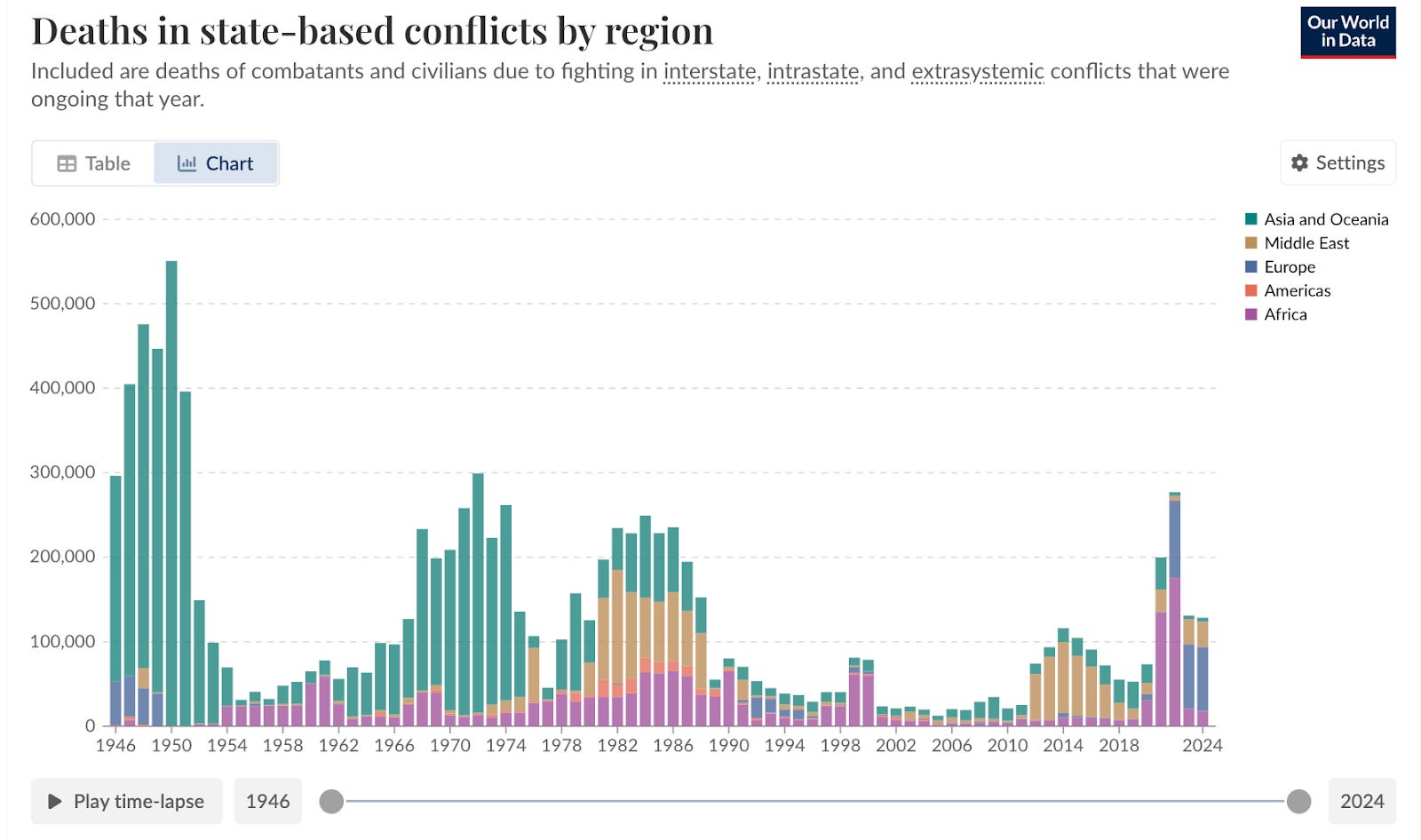
If you go anywhere, the belief that American interventionism has been a source of conflict is clearly the current consensus view. But this is insanity and predicated on a utopian view of human nature which has been disproven countless times.
Countries like Guyana, or Sri Lanka, or Estonia do not exist because of the strength of their own arms but because of American power. Additionally, America has been the single most effective decolonial force in human history. It was our pressure that forced the Europeans to abandon Suez, and pressure from FDR that forced Churchill to abandon any hopes of retaining India. The result has not been decolonial collapse, at least outside of Sub-Saharan Africa, and instead has been an explosion of growth.
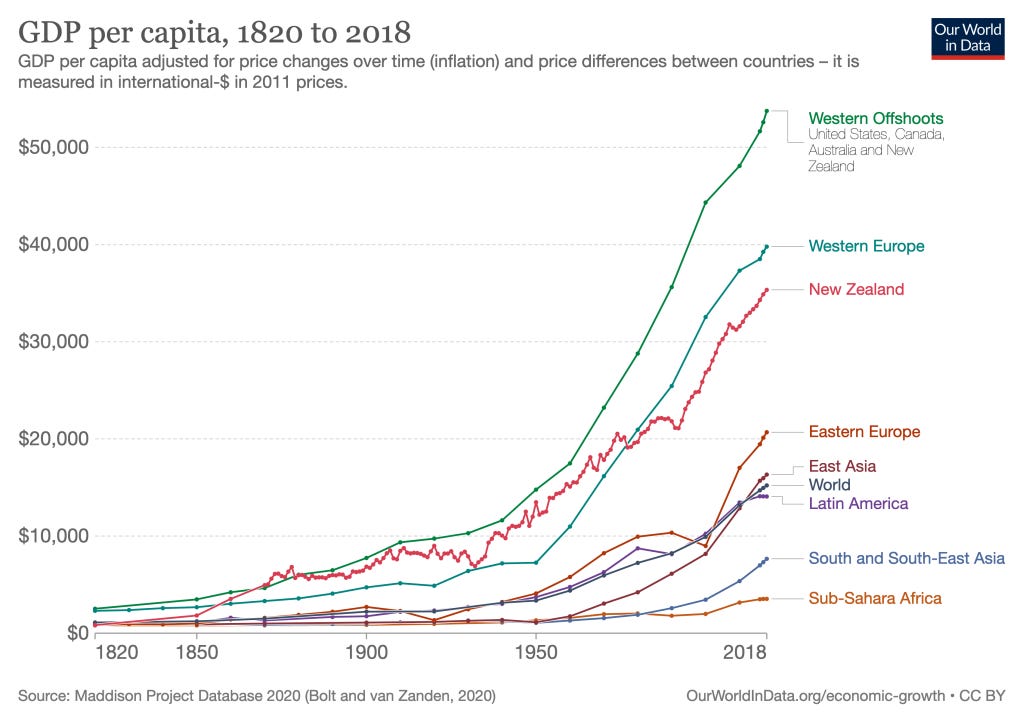
The post-War American Empire is the first, confirmed1, non-colonial empire in human history. Any honest examination of the invasion of Iraq or Afghanistan, for example, must engage with the fact that America poured trillions into constructing those countries and extracted almost nothing in return. Yes, our leadership class foolishly thought that what separated those countries from America was a patina of political institutions, but this naivety was driven by utopianism, not by rapaciousness.
When this era ends, if the American Empire internally collapses or is defeated by an opponent — think of China — it will result in the dissolution of the precariously assembled world order. Billions will probably die, and our unified World City, the result of imperial flattening, will eventually return to the default equilibrium of national competition. In the West we have lost sight of this, and any self-pride in the accomplishment of our ancestors has been replaced by a deep hatred of power and as a result a toxic self-hatred.
Americans should be proud of what we have created. The global order of international “equality,” where institutions are staffed by countries as diverse as Gabon and the Seychelles, and where international conflict is often negotiated from the precipice rather than litigated on the battlefield — all of this is a creation of post-War idealism and raw material strength. The second part is too easily forgotten, but it is the most important.
Nevertheless, we no longer wield a monopoly on force. And the global system will eventually be reformed, voluntarily or otherwise. Inevitably, it will shift from a system dominated by the US, and Europeans in general, to a truly global one. If this means interstate anarchy, or something else, is in our hands collectively.
I personally hope that the transition can be managed with as little war and suffering as possible, but I fear that is probably outside of the scope of human nature.
But as an American there is only one path: we have to remain strong and engage with the difficult and complicated nature of reality directly. An end of the American Empire doesn’t necessarily mean an end to our prosperity or security. My interest is in the right of the individual to life, liberty, and the pursuit of happiness but it is also in the survival of my Nation.
The pacific and cowardly worldview of the European is a slow death march for the world we live in. And the militaristic and revanchanistic worldview of the post-colonial nationalist and the Islamic extremist represents a rapid descent into barbarism. America must hold the middle path which acknowledges the necessity of action and the inevitable tragedy of conflict.
However, for now this post-War era of prosperity is closing, and as you sip your coffee this morning you should appreciate how spectacular the moment we live in is.
Whatever is next is up to all of us to build.
For $5/month or $50/year, you'll gain access to all my paywalled articles and earn a permanent spot in my heart.
Alternatively you can support me via buymeacoffee or by shopping on amazon while using my affiliate link
idk what was going on in the stone age.