We are the Soviets in 1972
That gives us some 20 years to prepare
Summary: The essay argues that the Soviet Union's collapse in 1991 was already inevitable by 1972 despite its apparent strength, because cynicism had spread through the elite class and prevented genuine belief transmission across generations. Drawing parallels to contemporary America, the author warns that a similar cynicism pattern is emerging among young Americans shaped by financial crisis, political dysfunction, and pandemic—people who will eventually inherit positions of power. He contends that institutions collapse not from external conquest but from internal loss of faith when elites perform beliefs without holding them, causing this cynicism to spread downward through imitation. The essay calls for ambitious young Americans to deliberately cultivate genuine belief in the nation and consciously steward America's inheritance rather than exploiting it.
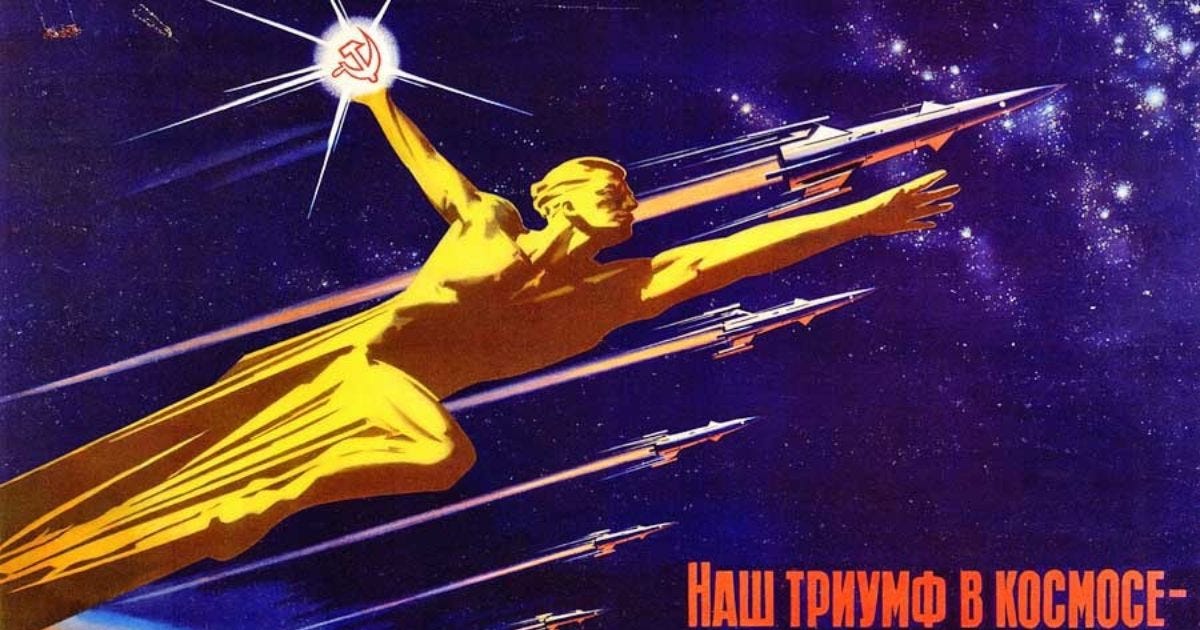
There are few subjects I find more interesting than the history of the USSR. This “riddle, wrapped in a mystery, inside an enigma” is a microcosm of the entire twentieth century and a foil to so many of the stories we like to tell ourselves about society.
Today, though, I’m particularly interested in a similarity I see between our society and the USSR in the twilight of its zenith. Namely: a broad cynicism among the elites which is rapidly spreading throughout society.
In 1972, to the entire world, the USSR seemed like a fact of nature—an immutable object of history which would survive, in some form, forever. And yet, only nineteen years later it would cease to exist.
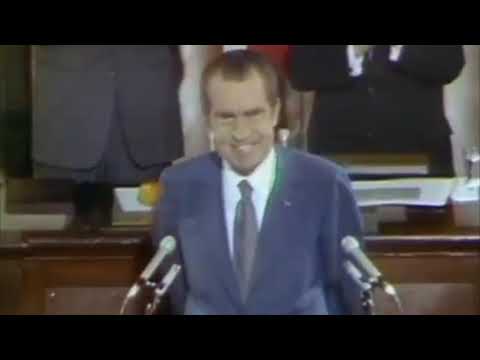
Looking back now, nearly all we can see is the slow slide down. When Americans imagine the USSR, it is the final years we picture: the economic dysfunction, the bleeding ulcer of Afghanistan, Chernobyl’s shattering of the state’s information monopoly, and spiraling nationalism. All of this feels obvious now because we already know it happened. If you picture yourself, though, in Moscow in May of 1972, as Nixon and the Soviets discussed arms limitations, it was obvious to no one, foe or friend. At a dinner in the Kremlin, Nixon declared that “the only way to enter Moscow is to enter in peace.” He was not speaking to the leader of a dying country, but instead acknowledging an equal.
On paper, the regime held enormous reserves of military power, near-complete control of the press and academia, and a deep professional and ideological administration. It had defeated Nazi Germany, put the first man in space, dominated Eastern Europe, and exported its power across the entire planet.
So was its collapse inevitable already at that moment? And if so—as I would argue—why was a society which was undeniably formidable, with no organized opposition and no obvious external conqueror, already doomed?
I think the simplest answer is that the generation of people who were, in that moment, working their way through the most prestigious schools and beginning to climb the ladder of social advancement simply had no faith in the Soviet system. They were, of course, masters at memorizing the chants and writing the essays. It is how they managed to succeed to begin with. But it meant nothing to them.
The dream of a Communist utopia, and the certainty of Marxist materialism, which ran hot in the old guard and which had been earned with blood in the Second World War, simply failed to transmit to their children.
This pattern of decline is far from a uniquely Soviet problem. Instead, it is one of the perennial patterns of decline in our collective history. Since we all eventually die, for an institution to survive any length of time it must eventually transfer authority across generations.
My argument is that this matters for a deeper reason than the familiar one about hypocrisy. We are Homo imitans: imitation machines, uniquely skilled at copying one another. Culture can be understood, in its broadest sense, to simply mean the sphere in which we imitate: the collection of people whose tastes in food, clothing, language, moral beliefs, etc., we copy. This imitation is, of course, not random and almost always follows the same gradient downward from the powerful, desirable—or, to put it another way, elite—members of society.
When successful institutions visibly perform beliefs they do not hold, people learn that belief itself is for losers. They learn that only a rube would allow himself to believe in anything.
The second power of a lie is its imitation.
This is the pattern which had become self-sustaining inside the Soviet Union by 1972, and I think it is the danger facing us now. There seems, to me, to be a wave of cynical young people whose critical formative years were the financial crisis, followed by the Trump years, and crowned with Covid. People my age simply don’t seem to believe in ~America~ in the way people older than me seem to, if for no other reason than that I’m not sure we can even define it coherently.

We young Americans forming our views and models of society today will eventually inherit it. This is our patrimony, the inheritance of a quarter-millennium of work, and something we have a profound duty to steward and pass on to the next generation. Many of you reading this are some combination of the founders, officers, artists, engineers, financiers, lawyers, writers, and civil servants now in their twenties and thirties who will actually hold the levers of power yourselves. This is not some esoteric hypothetical, but a very real problem worth thinking about now. If managing the decline of our current status quo until it inevitably crashes onto some rock isn’t appealing to you, no one will step in to stop it from happening. There will be an elite in 2050. The only questions are what it will believe its purpose is and how honorably its members will act in pursuit of those goals.
The answer I want to argue for is simple. Its purpose should be to manage, defend, enrich, and perpetuate the group entrusted to it: Americans. We should be delighted by the scale of the inheritance. We should want the responsibility, and we should spend the next several decades positioning ourselves, morally and professionally, to inherit it when the current system inevitably comes crashing down.
That is basically the entire article, and the remainder is merely the argument.
The imitative animal
One of the core, and often overlooked, aspects of Human psychology is the degree to which we are hugely suggestible and extremely prone to imitation. When I’m talking about ideas like suggestibility, I’m not only talking about the hysterical cases, such as hypnosis, cults, crowds, demagogues, moral panics, and people apparently losing control of themselves. What I mean by suggestibility is much more general: namely, our ability to mimic each other with incredible fidelity. From language acquisition to the transmission of cultural tastes, all of this is a form of suggestibility.
This is obviously not unique to Humans. Most animals mimic each other to some degree, but the extent to which we do it is truly astounding. If you were an alien examining Humans neutrally, the passage of imitative behavior in ebbs and flows across our planet would probably be among the first things you noticed: people all doing the same dances on TikTok, cars changing style together over the years, and our clothes and hairstyles seeming to spread like mental viruses across time and space.

Our tendency toward imitation is so obviously real that we barely even notice it. But why? Why are we this way? And what does it imply about us that we are so responsive to the actions of the Humans around us?
Recently, while searching the back catalog of mostly forgotten nineteenth-century academics, I stumbled upon Gabriel Tarde (1843–1904), in particular his 1890 book, “The Laws of Imitation.” I was immediately captivated by the book, less because I think Tarde’s system is correct than because it offers a different path for sociology. Rather than begin with society as some metaphysical thing standing above its members, he begins with the observable fact of people copying one another.
Tarde argues that socially, everything is either invention or imitation. An invention, in his sense, can be any modification in language, art, religion, law, industry, politics, or behavior. Somewhere a person does something new. Someone else sees him and copies it.
The book is in the nineteenth-century tradition of trying to replicate Newton. This means Tarde attempts to turn imitation into a general law of the social world and, in doing so, repeatedly overreaches and occasionally stumbles into mysticism. But I still find this idea extremely compelling.
At the time, Tarde’s approach competed with the emerging sociology of Émile Durkheim, and Durkheim’s school ultimately carried the field. There is a pleasingly delicious irony in how it did so. Durkheim built a cohesive group of students and collaborators who copied his methods, trained others to use them, and carried his work forward into history. In effect, Tarde lost the argument that immitation mattered to a superior pattern of imitation. Yet his simplest proposition has reemerged countless times because it describes something almost embarrassingly visible.
When someone talks about an ancient culture, what we mean is literally the sphere in which the remains we can find are copies of each other: where we find the same pattern of flint chipping, the same method of casting bronze, or, at the limit, the same way of writing, poems, and religious rituals. It is thus to this bundle of copied tools, burial arrangements, pottery styles, buildings, and ornaments that archaeologists give the name of ~society~.
This is because every object faces in two directions: backward as a copy and forward as a model. Our mental objects survive the same way. As I’m fond of pointing out, laws don’t enforce themselves. Nothing will leap out of a paper if you violate its precepts. It is only within the minds of Humans that the legal system actually exists in practice. You could write whatever you wanted down, and if this mental model didn’t change, the ~government~ wouldn’t either.
It is for this reason that succession is one of the perennial problems of Human existence. Because we all eventually die, any institution that survives must eventually transfer authority across generations. The person who built it has to give it to someone who did not, and eventually there will be no one who has any memory of the original context. The belief has to somehow transmit itself to another person through words, symbols, and actions alone.
Our most common heuristic for imitation is to copy what appears to work. This means we copy people who possess prestige, wealth, or anything else we desire for ourselves. Since individual discovery is expensive, and we have no sure way of accessing causality, copying someone visibly succeeding offers a cheap way to acquire whatever he seems to know. Sometimes we will do the opposite and symmetrically reflect our foes, taking on their virtues as vices and their vices as virtues.
The difficult part is that we see this object of imitation as a bundle. It is not possible to easily distinguish the traits which produced the victory from the traits which were merely correlated with it. If everyone rich seems to go to a certain school and wear a certain type of jacket while speaking with a particular vocabulary over a dinner of particular dishes, we copy the whole thing, or at least swaths of it, with little differentiation.
I think a great example of this is the rock-and-roll musicians of the 1960s. Starting probably with Elvis, America was enraptured by an obsession with our musical celebrities that turned them into figures “more popular than Jesus.” Simultaneously with this skyrocketing of their prestige, you begin to see all of society—in particular youth society, which was the most immersed in their sphere—changing. The clothes, hair, posture, slang, politics, and basic image of what it meant to be young began to reflect these idols as well.
Of course, this wasn’t because John Lennon was running a jacket company. Ultimately, it was an unnameable mass of designers, subcultures, television, magazines, record companies, and audiences who led to the cultural change, but they were all still imitating the same tiny cast of people. There is, then, a sense in which culture is the product of everyone but is steered by remarkably few individuals who sit at the pinnacle of society and supply the model for millions.
So is this bad?
No. I’ve not read enough Dawkins in detail to critique what he means by “memes,” but at least the way they have arrived as a meme to me, has always been deeply annoying. Most memes are not, despite how they are often portrayed, ideological pathogens which have seized control of our flesh vehicles to achieve their own ends. They are almost always things like forks, drinking coffee in the morning, language, hammers, military formations, and the expectation that a stranger will stand on one side of an escalator.
Parasitic forms can evolve anywhere persistence matters, and so it is doubtless true that some memes propagate in a way that is harmful to their hosts. But this is like saying hammers fall irrespective of their usefulness to Humans. It is, of course, trivially correct, but it uses a description of a property of the object to confuse you about its purpose.
I think that ant pheromones offer an apt analogy for Human mimesis, or imitation. When an ant encounters a pheromone trail and produces more of the same scent, from the narrow perspective of that ant, it might appear as if they were being puppeteered, as if the chemical was ultimately in control. But if you zoomed out a little, you would see that this description is absurdly incomplete. Pheromones are made by and for ants; they are the signaling-and-receiving system through which the colony coordinates itself. Thus, the entire collective ant body is in control of the pheromones just as much as the pheromones are in control of each individual ant.
Human culture works something like this, except our pheromone infrastructure is vastly more sophisticated and hardly constrained to crude chemical excretions. Instead, we produce words, symbols, images, rituals, institutions, and instruction manuals, to say nothing of Substack articles. These signals form the environment which shapes us, and then we modify and reproduce them, amplifying certain signals and dampening others. We are simultaneously in control and controlled, but what is most important to realize is that this is not an alien culture acting upon us from outside, it is an obvious extension of our Humanity.
So if we are both shaped by and shape our cultural environment, and ultimately it is up to a very small number of people to determine what that looks like in practice, then it matters enormously whether the small group which sits at the point from which signals travel farthest is seen as honest and good—or not.
The second power of a lie
There are as many ways to lie as there are ideas. But I think none is more corrosive today than elite cant, which teaches you to portray one set of beliefs externally without believing them yourself in order to succeed at climbing the status ladder.
Imagine an institution whose leaders constantly speak about a principle they plainly do not apply to themselves. At first, people may believe the principle is true, but once they notice the discrepancy, they will learn that the actual rule is to repeat the principle when required, recognize the private arrangement, and never be naïve enough to confuse either with reality.

In short, in this environment, the cynics are right not to believe. When successful institutions visibly perform beliefs they do not hold, people learn more than distrust. They learn that belief itself is for losers and rubes.
Of course, as I’ve been repeating, it does not stay there. A manager manipulates a target because his promotion depends upon it. In turn, his dutiful and conscientious subordinate learns to manipulate the input he is passing up. The central office knows that this is happening and so has to try to discount the report, creating another bureaucracy to audit the first one, which in turn requires another layer to audit it. Eventually, an enormous amount of Human effort is spent manufacturing claims and reverse-engineering them back toward reality.
Trust is what allows us to stop doing this and begin to specialize. I want the people responsible for food and medicine to competently assess whether something is safe because I do not want to personally reproduce their work every morning. Civilization is only possible because we can trust the delegates of our collective vigilance. That requires people to avoid taking private gains which harm society.

A functioning body of elites who can be trusted to govern over and protect us all is basically what we mean by society. There has never been an alternative to this in all of our history, and there never can be. This elite does not need to be metaphysically superior or individually perfect, its members just need to be competent, interested in the group’s collective outcome, restrained in using their positions, and willing to experience consequences for failure. Or, in short, they need to be model members of society because their behavior will literally become the model.
When they exploit the people who trusted them, the cost is larger than the immediate theft. It destroys the idea that our rulers care about us, and it shows everyone that extraction accompanies prestige, leading to spiraling immitation.
How the Soviets learned to believe
Returning to the USSR: to understand what went wrong by 1972, you have to understand 1945.
There is a version of Soviet history where everything is fraud all the way down: a criminal regime which lied to a captive population until eventually it all just sort of stopped. I’m far from a Communist or a defender of the regime, but this model cannot explain the Soviet Union because it cannot explain why anyone ever believed in it or why people were willing to devote their lives to furthering it.
What happened, in my reading, is that the Second World War, through a process of insane Darwinian pressure, reshaped the Soviet military and political class into a unitary and efficacious whole which was able to escape collective annihilation and raise its flag in Berlin. Put yourself in the shoes of someone like Nikita Khrushchev. Khrushchev was a “commissar,” which meant that he was a political officer of sorts. His job was to maintain party loyalty among the troops and ensure that orders did not deviate from the center’s commands. He fought for the entire war and was nearly killed on numerous occasions. He spent nearly the entire length of the Battle of Stalingrad camped out among the ruins while the blood machine ground down both sides.
Not only that, but the Germans had entered the war with explicit instructions to shoot captured Soviet commissars, so he must have experienced genuine animal terror in facing a foe which intended, in so many words, his annihilation. But what came out of that wrestle with the demon was victory—and not only victory, but total, absolute, crushing victory. By the end, Germany was throwing Volkssturm composed of young boys and old men at you from hovels, while your men were riding west on the back of a new T-34, with fresh equipment and the gleam of loot on the horizon.
To one of these young men the lesson would have felt obvious.
“Yes, we are poor. Russia was always a poor country, and the Revolution, Civil War, and Nazi destruction made it poorer. But we have turned the corner, and what stands ahead of us is the infinite poppy field of socialist utopia.”
This conclusion was wrong, of course, but standing where they stood, it was not insane. The Second World War created the USSR as we think of it today. It turned Russians, Ukrainians, Belarusians, Jews, Central Asians, Communists, Christians, peasants, workers, and people who had every reason to hate Stalin into a nation, and once the war faded out of memory, that nation went with it.
Ultimately, this is the grounding for Human association. We ally ourselves with those with whom we die. In the case of the USSR, it isn’t as if these nationalities became one harmonious family. Instead, they faced a simple choice: coordination or annihilation.
It is from this basic fact, which has repeated itself again and again, that we have developed our prosocial instincts. One academic framework for thinking about this is David Sloan Wilson’s work on group selection. But intuitively, it is not hard to grasp. From a Darwinian-fitness perspective, variation between individual Europeans or Native Americans mattered very little in the sixteenth century. What mattered for which side populated the Americas was aggregate collective fitness.
The Soviets experienced this same phenomenon from 1941 to 1945. None of this justifies Stalinism in some objective sense, of course—if that even exists—but it did allow them to turn every failure into a necessary cost. Victory does something strange to suffering. Because they sat atop the heap of corpses, they could look back at collectivization and, rather than see an obvious catastrophe, tell themselves that without industrialization the Nazi war of annihilation would have succeeded. If Moscow had fallen, no one would have called any of this necessary. Necessary for what? Necessary for defeat? No, suffering can only be minted into collective meaning by victory.
But vindication is an asset which can only be earned through experience. There was no way for the men who had ridden on the T-34s into Berlin, and who had an iron core of Communism, to transmit the phenomenology of their experience to the next generation. Their children could inherit the stories, rituals, institutions, and authority, but that was it.
Gradually, as failures within the state seemed to mount, victory was placed at the center of the civic cult. I do not think this was inherently fraudulent, but military victory is uniquely difficult to transmit to those who have only known defeat or peace.
Since the operative promise of the Brezhnev era was stability, things ossified and the goals shifted from managing the shared national patrimony to accumulating relationships organized around the continued tenure of apparatchiks. Think of the kind of person this selects for. Under this system the competent reformer is dangerous because reform creates identifiable losers, the sincere Communist is dangerous because he might take the official objectives too literally, the open cynic is dangerous because he risks exposing the game. Which leaves us only with someone who can memorize the cant, write the essays, understand the private arrangement, and never confuse any of it with the truth.
This conformism to cynical rent-seeking requires no examination or central advocate, because thousands of promotions, invitations, recommendations, and quiet decisions about whether another person is ~sound~ do all the work themselves.
In 1945 the Soviet elite admired courage, discipline, self-sacrifice, technical competence, and belief because those traits had just won the largest war in history. By 1972 the operational virtues were caution, fluency in the official language, management of appearances, and not creating a problem which required someone above you to make a dangerous decision.
Naturally, the slogans did not disappear, and if anything they became all the more common as genuine belief faded. People would still put out placards saying WORKERS OF THE WORLD, UNITE. But what could they possibly mean by it? The honest content would be “everyone should live like us”, and they don’t even want to live like themselves.
In that room, Nixon would have been surrounded by veterans of the war, which was at that point still fresh in everyone’s memory. Collapse was far from any of their minds, but the destruction was already brewing in their offices and colleges. The person who was thirty in 1972 was forty-nine in 1991. That cohort, which had been selected for the most functional form of cynicism, would eventually inherit the ministries, factories, universities, military commands, newspapers, and party offices.
And when the time came for all the officials who had spent years claiming to be willing to die for Communism to pay even the mildest price to defend the project, almost no one at any altitude believed in it enough to do so.
Our 1972
Our “1972” is not a prediction of a nineteen-year timetable to economic and state collapse, but instead a warning and a call to action. The old settlement, which I like to call the “Boomer Truth Regime,” remains powerful while the people preparing to inherit it increasingly understand its public language as a performance.
I’m not going to waylay you with polls showing the collapse in trust among young people; there are more than I could hope to enumerate. In this article I will simply take it for granted that the broad narrative of our time is the narrative of being scammed by someone—and often not without basis. Who exactly is the scammer and who is the scammee has as many variations as there are Americans, but it runs hot and deep for anyone willing to go looking. If you disagree and think that there has not been a collapse in trust than we simply disagree.
In my view, right now,an entire generation is metabolizing a belief that our institutions are basically corrupt, that our elites are basically incompetent or evil, and that anyone who does not see through it is somewhere on a spectrum from retarded to complicit.
Among guys like ~me~, this often produces exit. People want to get enough money to leave the pat on the head economy and avoid electoral politics because nothing ever happens. In other words, treat the entire official world as an embarrassing legacy system which somebody else can maintain.
Going and accumulating wealth is good. But ignoring politics is a mistake which you will pay dearly for if you do not change. Nothing happens until it does. And once it is happening, it is too late. Politics will care about you one way or another. It determines, and will always determine, the system in which your company, property, family, speech, and children exist. You can plausibly ignore that system while things continue on their prescribed path, but you are ultimately at its mercy, and this is a fact which must be grappled with.
It is not hard to imagine dark possibilities such as a fiscal break, a serious war, political violence, institutional fragmentation, or some combination of events we failed to predict. I do not know which rocks we are headed for, or even if we will hit them. But no matter what, the people in power today will pass, and a new cohort will rise to take their place. Old age alone guarantees this.
The inheritance
This article is not for everyone. It is for people like me: ambitious young Americans, particularly young men, who want to build the next thing.
Many of us do not think of ourselves as elites. We may have gone to “elite” schools or work at prestigious jobs, but we feel outside of the current consensus and dislike its symbols, newspapers, rituals, moral vocabulary, or policy assumptions. Fine. But we are elites whether we want to recognize it or not. Speaking for myself, I would feel fundamentally dishonest describing myself as anything else, even if nearly all of you probably earn more than me and I have power over few people. The fact that you are reading my stuff is evidence enough.
If you control capital, build technology, employ people, command soldiers, produce art, or change how thousands think, you are an elite in the only sense which matters. Your intentions will be translated into our collective psyche one way or another.
That is not something to shirk from or pretend you wish were not true; it is also not something to gleefully gloat over. It is a fact to inhabit consciously, aware of its delicacy.
Money makes the dynamic easiest to see, in my opinion. A billion dollars is nothing more than a claim upon an organized society whose laws, currency, energy, logistics, labor, and technical knowledge can transform numbers on an Excel spreadsheet into actions and materials.
You do not exactly owe society something in the moralized way the phrase is normally used. The relationship is more direct than that: its death and your impoverishment are deeply connected. As Americans, there is no other choice, nowhere we can go to hide from the long arm of the state. Any power you have depends upon the continued existence of ~this~ thing. I would therefore argue that taking America seriously is intelligent self-preservation.
And what an inheritance it is!
In a historical blink of an eye we will inherit the world’s most powerful empire. A smart, driven American has at their hands more usable civilizational leverage than almost anyone who has ever lived, we simply cannot let it rot in the barn.
Part of what should distinguish us from the current elite is loyalty to this country. Not because America is abstractly identical with Humanity, and not even because America is the best country on the planet, although I would argue it is. No, we should be loyal because it is ~ours~ and managing it will be ~our~ job. A CEO has a fiduciary obligation to manage his company, not to help “the economy” in the abstract. Similarly, the purpose of an American elite is to manage the group entrusted to it: Americans.
That should be our telos:
Defend the country, enrich its people, and preserve the inheritance so we can hand something greater to those who follow us.
Every generation of elites, no matter the individual importance of its members as unique Humans, is simply a passage through which our country must pass, and it is against this reality that an elite must be judged.
I think more than anything the process of building a new counter elite must begin with self-identification. YOU should want to sit in the seat of power. YOU should also want to deserve that right.
But it is worth realizing that we do not need to convince 350 million Americans to change their minds. Instead, we only need to convince and cultivate the few thousands of young people who will be the models the rest of society encounters. If you win enough of them to a better consensus, the direction of imitation will change on its own.
This will take our entire lives. Meaning it is not something we accomplish tomorrow. But if we do not do something soon to avert the trend we will lose the window of opportunity. This matters because when our time comes to be the passage through which this country passes, we must do our duty and live up to the performance of our ancestors. The Soviets who inherited power in the late 1980s received an immense pile of plunder and a dead purpose, we cannot repeat that pattern, or our twilight years will be marked by chaos and robbery.
We will be the Soviets in 1989 only if we refuse to plan a better path.
There will be an elite in 2050. It can be loyal and competent, it can believe power is good when used to advance the people whose power they are entrusted with, and its members can understand themselves as models whose successful actions encourage imitation. We do not have to settle for careerists or status climbers and there is nothing stoping us from reforming things, we have done it before.