India, China, Africa, and Progress
A gradual return to "normal".
Summary: The essay argues that China and India's contemporary economic rise represents a return to historical normalcy rather than an unprecedented disruption, as these civilizations were wealthy and developed centers until the 19th century. The author contends that the Industrial Revolution created divergence only after the mid-18th century, and that the 19th century constituted a disaster for Eurasian civilizations whose effects persist today. He rejects the modern tendency to group China, India, and African nations as a homogenous Global South, arguing this reflects Western ignorance of pre-modern history. The essay suggests China's rise reflects inevitable reversion to historical parity, while India's different developmental path, shaped by colonial impacts, demonstrates alternative approaches to modernization.
It is so frustrating hearing people talk about the rise of China and India as someone who loves global history, because it requires a sort of willful ignorance to maintain the illusion that it was unexpected.
For $5/month or $50/year, you'll gain access to all my paywalled articles(including this one) and earn a permanent spot in my heart.
China and India have always been wealthy centers of Humanity; this simply isn’t up for debate. In fact, by almost many definitions of social development, both India and China spent much of the millennia between the fall of Rome and the rise of the European global empires in the 15th and 16th centuries more advanced along nearly every dimension than my civilization.
For a careful documentation of this fact for China and the West, I suggest you read The Measure of Civilization by Ian Morris.
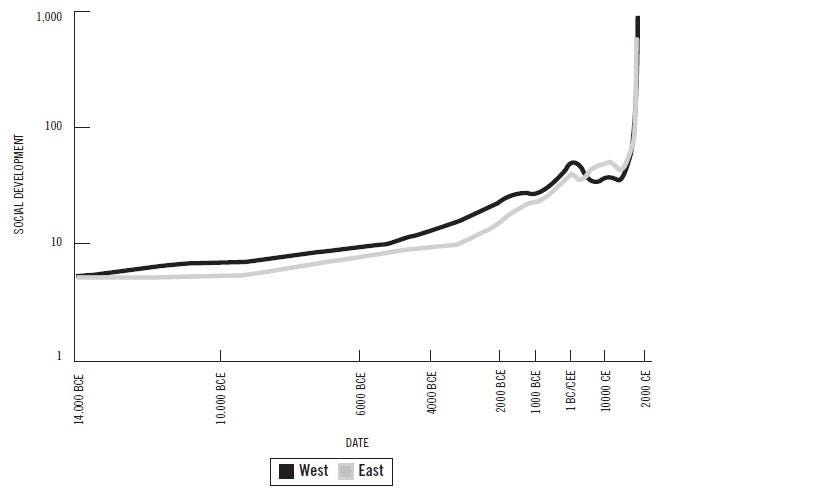
Even by the end of 17th century, despite a rapid ascension, “White” civilization was far from some globally all-powerful force. It was only after the Industrial Revolution that a technological gap became a chasm. The Great Divergence by Kenneth Pomeranz argues that as recently as 1750, the wealthiest regions of China and the West had similar profiles of economic development, and real divergence began only after the mid-18th century1.
Rather than an explosion of European civilization, I think a better model of human history would represent the 19th century as something of a disaster for the non-White Eurasian civilizations, one whose consequences we are still feeling today. For reasons I don’t think anyone fully understands, the Gunpowder Empires that ruled the Near East (Ottoman), India (Mughal), and China (Qing) all entered a steep period of secular decline just as European civilization was reaching the apex of its power.
Nevertheless, when looking at the following graph of per capita income for the 54 years between 1964–2012 one can walk away with the false impression that China, India, and Kenya all composed some homogenous block of poor countries. This means that sociologists and economists spend an enormous amount of time trying to figure out why China has done well, India has done fine, and African countries—like Kenya—have done poorly.
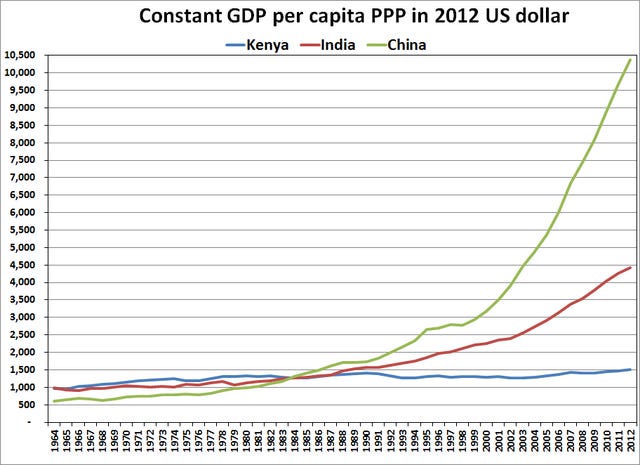
I would contest that these countries pretty clearly do not compose some homogenous “Global South,” and maintaining this perspective of world history is only possible because of the total ignorance of the pre-modern world by Westerners.
If you expand the time frame out just slightly, the world’s economy looks like this.
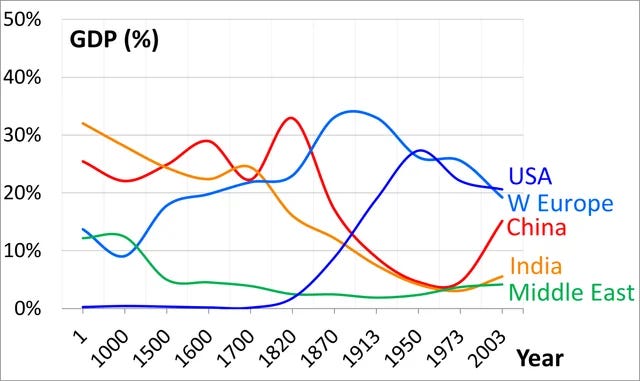
Here, the four major Eurasian civilizations are all in rough parity until the 19th century, at which point India and China collapse—arguably were pushed. Notably absent from this chart is Africa, and this isn’t because of some erasure of African people, but instead because Sub-Saharan Africa really was much, much, much poorer than the rest of the world for the entire historical record.
Literacy barely existed, and much of the continent lived as Iron Age monarchies roughly analogous to Celtic Western Europe before its conquest by the Romans. Again, this isn’t how Western society likes to think about the pre-modern world, and it is popular to talk about figures like Mansa Musa. So if this is how you feel, I sincerely encourage you to actually look into the details of pre-colonial West African civilization.
The result of our historical ignorance is that the 20th century has been defined by what appears to be a wide variation in policy success, when in reality China’s rise is simply a return from a period that is so weird that if the graph above had a consistent timescale, it would look more like an error than a trend. It is still worthwhile comparing the relative success of India and China, since they have taken radically different approaches to development, and I sincerely believe that India’s broad-based democratic institutions will pay off in the future, even if they have restricted the ability of the state to force-feed modernity to the degree China has. But I also think we are mistaken if we underestimate the catastrophic effect the Raj had on development.
Since, if nothing else, China was never exposed to the capricious central planning of a colonial elite committed to a social reorganization of a society they didn’t understand—instead, they had the privilege of having a domestic caste committed to this same destructive vision. But I’ll gladly bet every red cent I have that by the end of this century, the world will look much more “normal” than it has at any point in the last 300 years.
None of this is meant to downplay the massive effort that has gone into building modern societies in India and China—any more than I would downplay those same efforts in White civilization—but an honest accounting of history would imply that it was “inevitable,” and the process has been more a manifestation of destiny than some shock.
Of course, the causes of this divergence preceded that date.