Girls are Bayesian, Boys are Axiomatic
My first foray into gender slop.
Summary: The essay argues that men tend to be axiomatic thinkers (holding firm core premises and deriving everything from them), while women tend to be Bayesian (continuously updating their beliefs based on new evidence). This fundamental difference in information processing explains various behavioral patterns including friendship maintenance, ideological commitment, and social dynamics. Each cognitive style creates distinct pathologies when mismatched with the modern information environment.
Theory: men tend to be axiomatic in their beliefs in the sense that they lay down a set of core premises and derive everything else from them, whereas women tend to be Bayesian and so continuously update their models as new information comes in. When a guy becomes a Marxist he literally believes in Marxism as a coherent ideology which is consistently true. When a girl becomes a Marxist she is fully capable of simultaneously believing that markets are pretty good actually, because the evidence for that is strong too.
I think this explains why men can go years without talking to a friend and pick up like nothing happened, and why women seem to track every micro-interaction in a room. It also explains why men whiplash violently between commitments while women spiral into anxious uncertainty.
Recently I had the great pleasure of going on the Ancient Problemz podcast where the host and I rambled about the state of modernity for almost 3 hours. It was a ton of fun and it, along with my experience on Walt Bismark’s podcast, really reminded me of how much I love yapping. If you ever want to have me on just hit me up.
But one of the things we touched on was my theory about the way that men and women, on average, process information. Specifically, I have a belief that men tend to be axiomatic and women tend to be Bayesian. Candidly, I had never really considered the thought that this might be a “unique” idea until I saw this very fascinating note by “Kryptogal (Kate, if you like)” come across my feed where she engaged with the idea seriously.
Since that note has over 100 likes and there seems to be some general interest in the idea, I thought I would take the time to explain what I mean by this theory, anecdotally why I feel it is true, and what it says about the modal types of strengths and neuroticism associated with these different models of information.
So, to begin, what do I mean by “Bayesian” and “Axiomatic”?
What is the best way to process information?
At risk of delving into the murky and dangerous waters of epistemology—how we know what we know—there are broadly two ways you can “know” something about the world. The first is to lay out some core “facts”—or axioms—and then interact those axioms to develop propositions which, if consistent, are themselves also true.
Classical Euclidean geometry is the best example of this because it begins with a very simple set of axioms which are intuitively obvious to anyone alive. These are:
The shortest distance between two points is a straight line
A finite line can be extended indefinitely in a straight line
A circle can be drawn with a center and any radius
All right angles are equal
If a straight line intersects two straight lines and makes the interior angles on one side sum to less than two right angles, then those two lines will meet on that side if extended far enough.
If this last one jumps out as odd, that is because it is1. But what is core is that these beliefs are taken as true without themselves requiring proof; they represent the basic substrate of the information environment in geometry, and by just interacting them you can derive some pretty zany stuff which, to me as a child, felt deeply unintuitive, like the Pythagorean theorem.
The enormous advantage of this way of thinking is that you know, conditional on the axioms being true, that anything you derive is 100% accurate. No one has to ask what day of the week it is, or if the moon is in retrograde, to figure out if the Pythagorean theorem is true—it just is.
But this certainty comes with a high requirement of faith in the initial axioms; if they are wrong, the entire system comes crashing down, so finding good axioms isn’t easy. Because it isn’t just necessary for the axiom to “usually” be true—you are accepting it by definition as ALWAYS true. This is a problem that classical economics ran into when it tried to construct models of human affairs, because no matter how much we tried to reduce our behavior to a small set of statements, people had a way of proving them wrong, one after another.
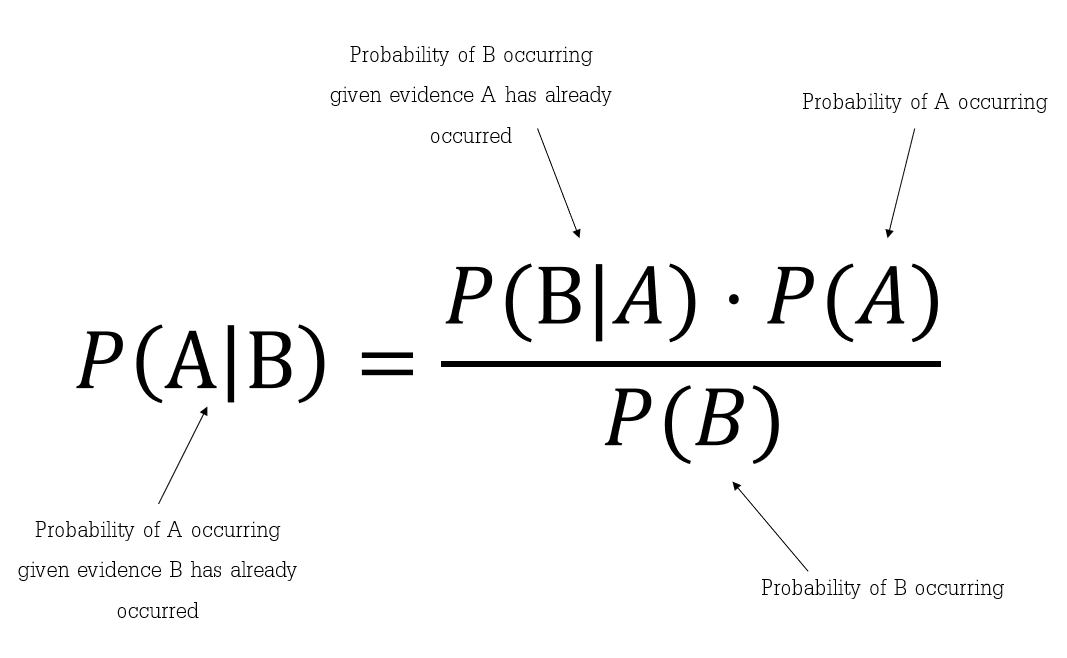
This brings me to the main alternative way of “knowing”: Bayes’ Theorem. Unlike axiomatic thinking, Bayes’ Theorem takes uncertainty as a core part of its model and instead offers practitioners—called Bayesians—a tool to operate within uncertainty. Literally, what it says is the following.
Let me illustrate with some specific numbers.
Trigger warning: MATH

Suppose there is a form of cancer that affects 1% of the population. Doctors have designed a test for this cancer that is extremely accurate—it correctly comes back positive if you have the disease 99% of the time—but there is also a small chance of getting a false positive, say 5%. You go into the doctor one day, get the test, and it comes back positive. What is the actual probability you have this cancer?
Why? Well, let’s plug the numbers in.
P(Cancer | Positive Test) = \frac{P(Positive | Cancer) * P(Cancer)} {P(Positive)}P(Cancer | Positive Test) = \frac{0.99 * 0.01} {P(Positive)}The only variable we don’t already know is P(Positive), but we can derive this from the other information we know. Specifically,
\begin{aligned}
P(\text{Positive})
&= P(\text{Positive} \mid \text{Cancer}) \cdot P(\text{Cancer}) \\[6pt]
&\quad + P(\text{Positive} \mid \text{No Cancer}) \cdot P(\text{No Cancer})
\end{aligned}
\begin{aligned}
P(\text{Positive})
&= 0.99 \cdot 0.01 \\[6pt]
&\quad + 0.05 \cdot 0.99 \\[6pt]
&= 0.0099 + 0.0495 \\[6pt]
&= 0.0594
\end{aligned}\begin{aligned}
P(\text{Cancer} \mid \text{Positive})
&= \frac{0.99 \cdot 0.01}{0.0594} \\[6pt]
&= \frac{0.0099}{0.0594} \\[6pt]
&\approx 0.1667
\end{aligned}Basically, because the “base rate” of cancer is so low, most people who get a positive test, even if it is very accurate, are getting a “false” positive, meaning you should probably go get a second opinion before you run off and write your will.
So how and why are guys axiomatic and girls Bayesian?
Taking a step back from epistemology and back to the central thesis of this article, I’ve spent a lot of time with both men and women, and it is remarkable the degree to which they fit these models anecdotally, both for good and for ill.
In general, men will tend to have a set of beliefs that they hold onto very closely and which they update very irregularly. They use these beliefs to then go about constructing models of reality which, conditional on them being right, are internally self-consistent and stable. For example, a guy might believe very strongly in Marxism and take it as self-evidently true and then go around looking for nails to hit with this theory and regimes they need to defend. Or, less seriously, they might take a person’s friendship as self-evidently obvious and, bar some sudden revelation, be able to go decades without speaking to the person and then pick up exactly where they left off.
By contrast, girls tend to notice “everything” and in turn gradually update their models with new information. For example, a girl might be a Marxist but might also have no problem holding the apparently contradictory belief that markets work because there is good evidence for that. Rather than Marxism being 100% true in all cases, instead it might simply have a strong “prior,” but that by no means precludes exceptions. Going back to the friendship example, I’ve noticed this as well: girls tend to have much more subtle and complex networks where each person sits somewhere on a spectrum of friendship and “everything” they do moves it one way or another.
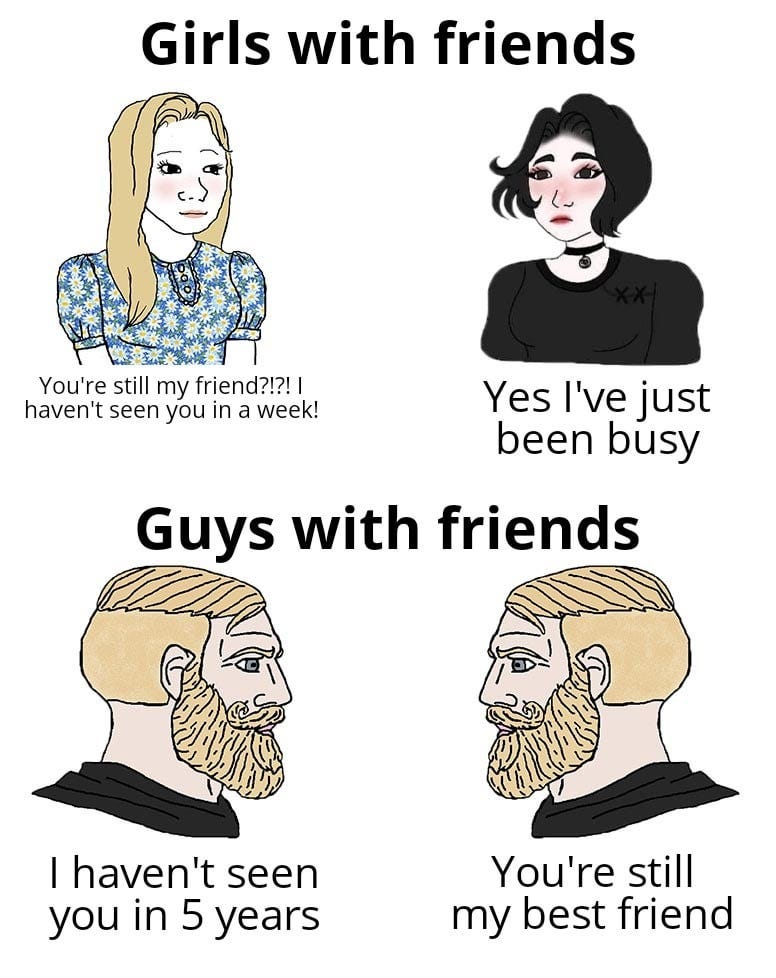
Ancient Problemz pushed back against me in our podcast on this, but it is truly remarkable to me the amount of information girls are able to internalize about an environment very quickly. I’ll leave an occasion and be like “that was fun” or “that was lame,” and my wife will have instead developed an intricate map of everyone’s behavior that night and, in turn, have opinions, of varying strength, about everyone involved. Literally, the information slides right off my smooth brain as not important enough to update a core axiom—maybe the party was just bad for no reason! Idk.
From a mammalian evolutionary perspective, I think this makes a lot of sense.
For most of human history, men and women faced systematically different informational and coordination problems. Men were more often tasked with activities where success depended on committing to a small number of stable assumptions and acting decisively on them: hunting, fighting, territorial defense, tool use, hierarchical competition—all require the actors to have firmly held positions which do not differ much in the face of evidence. When you and the homies are charging the subhumans from another tribe, it isn’t very helpful if you are changing your model of their moral value. No, the only path now is to truly “believe” that you will win and that the victory is totally morally justified; any updating has to happen ex post, once the carnage has stopped.
Women, by contrast, were more often embedded in dense social environments involving child-rearing, kin networks, resource sharing, and alliance maintenance; threats they were exposed to were often “within” the group and so needed to be dealt with. Nothing I listed above is a binary problem; instead they are all inherently probabilistic, interpersonal, and highly contextual. The cost of missing subtle shifts—who is trustworthy today, who is resentful, who is unreliable, who is dangerous—can compound slowly but catastrophically. Your friend isn’t returning the pot they borrowed? Maybe this means they are upset at you for something that you did a month ago, and it is worth checking in on them now, before the tension spirals out of control.
So in modernity, what neurosis does this create?
Bluntly: each style is badly mismatched to large parts of the modern information environment, and the mismatch expresses itself as predictable pathologies.
Men, mostly axiomatic thinkers, in a world of actual uncertainty tend toward rigid beliefs which can swing unpredictably. In her note, Kate said the following, and it resonated with me a lot as an ex-Mormon:
“Like living in Utah, I have watched a lot of people change/lose their religious faith, and about half of the men come swinging sort of violently from hard-core true-blue belief into the opposite in a very short period (often with utterly chaotic and devastating impact on their life)”
…
“Also, men seem to often be rigidly axiomatic about their economic beliefs, treating them as almost religious in nature, and fairly impervious to either new information or doubts.”

I’ve noticed this in a lot of guys who will suddenly whiplash against a person or an ideology and go very quickly from totally trusting or loving them to hating them with a deep passion. If you’ve been on X, you might have come across the account “Drew Pavlou,” and I think he is a great example. Basically, he used to be a committed liberal until one day he was mugged, and it seemed to genuinely reorient his entire metaphysics like the snap of a finger. Anecdotally, my own experiences in the South Side operated in a pretty similar manner. There are a lot of reasons basically every terrorist is a guy, and one of them is that I don’t think anyone but a guy could believe anything enough to blow themselves up.
Turning to girls, Bayesians, they tend to be characterized by a need to search for constant signals—is this celebrity actually bad? Are my friends all mad at me?—and as a result tend towards anxiety and needless uncertainty. Since everything is evidence, everything has to be noticed and followed, and as a result their models often don’t ~converge~.
Since modernity supplies a firehose of signals girls can sometimes end up in positions which I can only describe as socially constructed and totally inconsistent. In personal lives this also causes havoc, and I have personally observed entire female friend groups collapse into a bad signaling environment where a simple backstop of “hey, we all love each other”—which would bind in male dynamics—fails to ever arrive, and love turns to ambivalence to hate slowly but with a doom march of certainty.
Conclusion
I think there are a lot of advantages to both systems, and candidly I think men and women operate best as a team when they can coordinate the various strengths and pathologies together. So rather than there being a hierarchy of minds, instead men and women face a coordination problem.
Axiomatic thinking is extraordinarily powerful when the environment is stable, when decisive action matters, and when second-guessing is more costly than being wrong. It produces conviction, loyalty, courage, and the ability to act under uncertainty without freezing. It is also brittle. When the axioms fail, they tend to fail all at once, producing ideological whiplash, scorched-earth reversals, and in extreme cases, total identity collapse.
Bayesian thinking shines in environments that are noisy, social, and adversarial in subtle ways. It allows for nuance, adaptability, and the detection of weak but important signals long before they become obvious. It is also exhausting and encourages questioning of positions which really should be taken as “true” to operate in reality.
Look, I’m a centrist at heart and I love both men and women.
For my paid subscribers only: A spicy theory using this model for why male friend groups persist and female friend groups implode.
So I have another theory of humanity I call the “weakest link” theory. Basically, what it says is that every friend group of three or more “units”—couple friend groups don’t really have this, in my opinion—whose main form of interaction is outside of work has someone who is the “weakest link”: basically the person who everyone is always a little annoyed at. They are the stupid, or awkward, or weird one who, when they happen to not be able to join, everyone has a little more fun. It is just normal that there would be a person who fits in least well as a member of a group, and this doesn’t say anything about the inherent value or likability of the person. I have been the weakest link in friend groups before; everyone has. But it is an inevitable “fact” of group dynamics in my experience.
Now, because guys are axiomatic, they tend to take the positions in the friend group as sort of “given” after a brief period of jockeying and then mostly go about trying to fill that role well. So your group might have a “commander,” and/or a “jokester,” and/or a “ladies’ man,” but they each provide special skills to the group and each could in theory be the weakest link. Because guys take these positions as basically fixed, there isn’t a constant ongoing process of litigation wherein men in the group are trying to dethrone one another. There might be competition over a desirable role like commander, but 75%+ of guys are fine with their spot in the group and don’t engage in this type of conflict.
By contrast, female friend groups are characterized by a basically fluid hierarchy. Note: there is still very much a hierarchy, and the same (or similar) roles to what I described above, but unlike in a male friend group where it is fixed, in female dynamics it is in a state of constant flux and competition. As a result, the interpersonal conflict never ends. I would say basically the proportions are inversed: if in a male friend group only 25% of men engage in constant interpersonal conflict, in a female friend group that proportion will be 75%. The result of this is that the groups are unstable, and the composition of a girl group will ebb and flow with a degree of instability which makes me, as a guy, blush.
The fifth axiom, Euclid’s parallel postulate, is weird because, unlike the others, it is neither simple nor intuitively obvious. Without it though you basically cannot have geometry which makes any sense. As a result for, mathematicians believed for millennia it must be derivable from the first four axioms so as to reduce the system to only “reasonable axioms.” In the 19th century mathematicians like Gauss, Bolyai, and Lobachevsky showed that you can relax the parallel postulate and still get perfectly consistent geometries, however this geometry is ~weird~.