3 thoughts on our Special Military Operation
reflections on the most recent news
Summary: The essay examines a reported U.S. special forces operation to kidnap Venezuelan president Nicolás Maduro, with the author expressing confidence in American military superiority while remaining uncertain about the intervention's ultimate consequences for Venezuela. The author defends American military capability by contrasting it with Russia's failed attempt to capture Zelensky, arguing that narratives of American decline have obscured the nation's continuing dominance. The essay concludes by observing that Americans remain passively willing to follow their government down almost any foreign policy path, whether imperial expansion or nationalist retrenchment.
As I write this, I’m sitting in Terminal E of SFO, drinking a White Claw and appreciating, poignantly, the pleasures and fragility of my affluent modern life. For the past five days, I’ve been in California visiting friends remembering why I loved the state, despite its obvious frustrations.
What I wanted to reflect on today, though, was the most recent American intervention in Latin America—namely, the reported kidnapping of Venezuela’s president, Nicolás Maduro, by U.S. special forces. Since this moment is very much in flux, I’m not sure anyone—Trump included—fully knows what is unfolding on the ground right now or where the loyalties of the government, which broadly remains intact, are tending. Still, this feels like a consequential moment, and capturing how I feel at the very dawn of 2026 may have some value, if only as a record.
How I feel about this will depend on how it goes.
Look, I’m not going to cry crocodile tears and pretend I care about the rights of the socialist inner clique that rules Venezuela at all—I don’t. However, Venezuela deserves, as all countries do, to be prosperous and sovereign, and I hope that Trump does nothing to foreclose this. Annexation or a permanent American occupation force would be disastrous and do nothing to benefit either of our peoples.
But I also have doubts about the plan that seems to be unfolding right now. It is possible the Ancien Régime will persist in a more cowed form, and it is also possible that it could undergo a genuine transformation. Trump has talked about American companies coming in and developing the oil in Venezuela, and this seems quite likely to me—Trump would love to continue lowering gas prices—but beyond that I have zero clarity on what is going to happen, and frankly I don’t think Trump does either.
Now, Trump and I not having clarity isn’t the same as saying this situation is going to go poorly, or even that the plan is bad and you should have clarity. Human affairs are messy, and Trump is—obviously, whatever else you feel about him—an intuitive genius who has acquired and retained power for a reason, all without ever appearing to show the slightest clarity on what he is doing. This could easily be another in a long list of events that reasonable people have predicted will lead to disaster but which instead leads to an unexpected victory by Trump.
If Venezuela turns out well, I will praise this; if it doesn’t, I will decry it. Simple as.
It is my right as a citizen to stand in judgment of my government, and Trump has cast the die. One way or another, this will be an event that defines his presidency.
Our military is still the best.
No other country could have plausibly pulled off what we appear to have done.
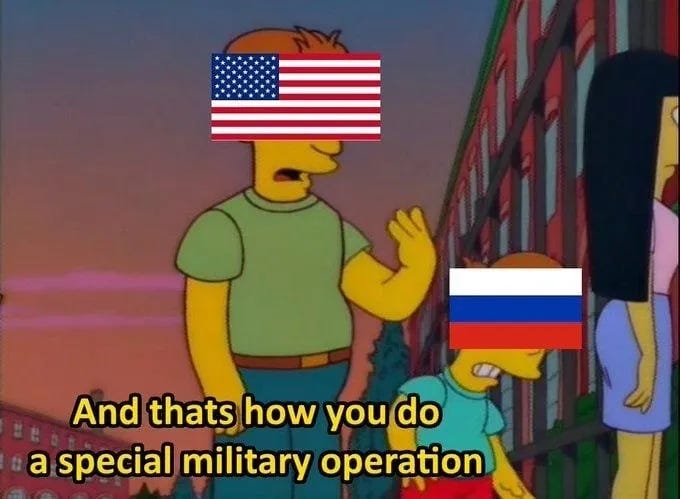
Yes, Venezuela is not a strong country. But people asking, “What would we say if Russia did this?” forget that Russia tried to! It was Zelensky’s bravery and Russian incompetence that saved him from their clutches, not the soft appeals of internationally minded liberals.
We’ve become so saturated in narratives of American decline that we’ve forgotten we remain the top dog for a reason.
Americans will, mostly, passively follow any path.
Temperamentally, I’m torn between an appreciation of the American Empire as the arbiter of the global system—a system I believe represents the most expansive golden age in human history—and a sense that we can no longer pretend to exist alone in the world.
America is still, by far, the most powerful country on Earth—but it is no longer the 2000s, and we are not the only consequential power.
From where I sit, it increasingly seems that America must choose between being a normal country and being the cosmopolitan imperial core of a world empire.
Biden’s four years in office appeared oriented toward the latter: tightening alliances and letting in millions of immigrants. Trump’s first year has reflected the former.
What strikes me is the passivity with which the American public moves between these extremes. Whatever course our government ultimately settles on, Americans will go along with it; we don’t appear to collectively feel strongly either way. Even if we stumble into a ground war in Venezuela—even a grinding, ulcerous one—there will be no draft and no meaningful change to our taxes. And so, most Americans simply won’t care.
Likewise, if we continue to violate the international system we built, Americans won’t care much about that either. Yes, we’ll complain—it’s our favorite pastime—but as a society we seem prepared to follow our government down almost any path.